
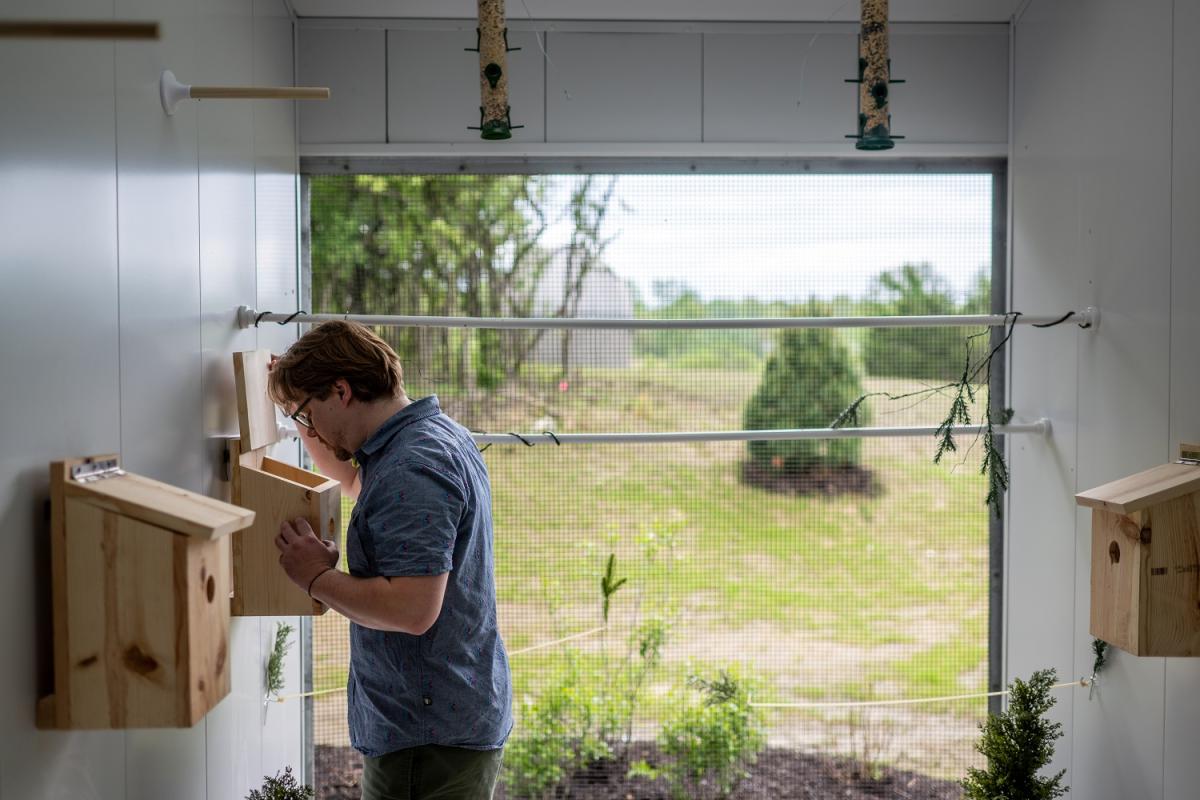
For researchers studying wildlife, innovation often begins with a challenge. For Dr. Tosha ("Tosh") Kelly, a Research Associate in 黑料网's Trevelline Lab, that challenge was deceptively simple: how might we safely collect uncontaminated samples from wild sparrows while minimizing stress on the birds and maximizing research efficiency?
The answer ultimately came through a collaboration between KSU鈥檚 Biological Sciences Department and the Design Innovation Hub's Reactor makerspace鈥攁 partnership that transformed an idea into a practical research tool that now supports ongoing avian microbiome research.
Studying the Hidden World Inside Birds
Kelly studies the complex relationship between birds, their microbiomes, and disease outcomes:
"I am a Research Associate (faculty) in the Trevelline Lab of 黑料网's Biological Sciences Department. The Trevelline lab studies how microbial symbionts (the microorganisms living in or on a host) shape the ecology and evolution of their vertebrate hosts. I provide an immunology perspective to this research program by investigating how gut microbes affect immune system development and disease outcomes in a zoonotic host, the house sparrow (Passer domesticus)."
Understanding those microbial communities requires the collection of large numbers of poop samples from birds in both field and laboratory settings. While the science is complex, Kelly notes that working with birds presents its own unique challenges.
Studying birds is very challenging. With the ability to fly, they are difficult to catch, handle, and contain.
Yet those challenges are worth overcoming.
"I am motivated to overcome these challenges because of my admiration for birds, how they connect communities 鈥� animal or human, promote ecosystem health, provide social and economic benefits, and remind us of our responsibility to the planet."
One of the least invasive ways to study avian microbiomes is through fecal sampling. To support that work, Kelly needed a way to safely contain birds while collecting uncontaminated samples for microbiome analysis that can be standardized for field- and lab-based collections.
Introducing the 鈥淧oop Coop鈥�
Originally known as the Sparrow Outhouse and now officially named the "Poop Coop," Kelly's custom-designed enclosure was created specifically to support microbiome research.
The Poop Coop is designed to safely contain wild sparrows while allowing controlled, uncontaminated sampling of sparrow poop for microbiome analysis.
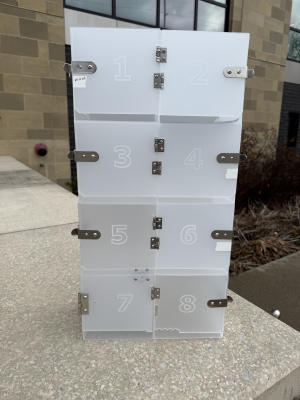
The enclosure includes eight individual compartments with elevated wire platforms that separate birds from collected samples. The doors of the enclosure are elevated below the grate to observe when defecation has occurred and allow the researcher to retrieve the sample while minimizing contamination and subject disturbance. The idea emerged from a common challenge faced by wildlife researchers.
"Lots of wild birds escape from conventional cages because they can escape three different ways when the door opens or closes (up, down, or to the side). So, we 3D-printed a door port using a flexible filament that cups the researcher鈥檚 hand while placing the subject in the enclosure. This is a game changer for me because, since implementing this door port design, we have not had a single house sparrow escape during fecal sampling. That saves us time, grant dollars, and 鈥� to be completely honest 鈥� sanity."
The resulting design provides a practical solution that can be adapted for additional research applications beyond microbiomes and birds.
"Field researchers interested in wildlife gut microbiomes stand to benefit from the design鈥�, according to Kelly, who notes that "The Poop Coop can be scaled to accommodate larger birds and is suitable for reptiles and amphibians."
Turning an Idea into Reality
While Kelly had a vision for the project, transforming that vision into a functioning research tool required fabrication equipment, design software, and technical expertise.
"I heard about the DI Hub from the lab's primary investigator, Dr. Brian Trevelline, and became excited to have experts help make my specialized equipment."
Working alongside Reactor staff and student employees, Kelly used MakerCase software, Adobe Illustrator, and the Reactor's laser cutter to fabricate the enclosure from acrylic components. Like many prototype projects, the Poop Coop required testing, troubleshooting, and refinement along the way.
Sometimes the laser didn't cut all the way through, so a student team member showed me how to increase the strength of the laser and also recommended that I do not move the acrylic before re-cutting.
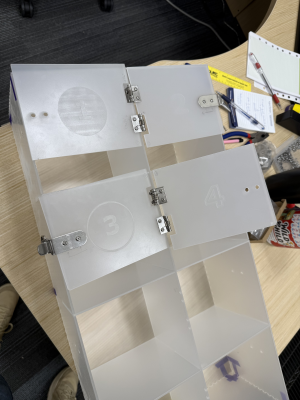
Kelly also found herself brainstorming solutions with Reactor staff as the design evolved.
"I also struggled with how to fasten the door closed. I was working with hinges and Shannon [Shannon Hines, Manager, DI Makerspaces] recommended magnets. We ended up with cabinet clasps/latches but Shannon was always helpful in brainstorming for the project."
For Kelly, the experience highlighted the value of collaboration.
"I consulted with three student team members on how to use the laser cutter, and Shannon Hines helped access Adobe Illustrator software and offered many design ideas for the project. I always felt welcome and I genuinely felt that the DI team cared about the success of my project."
Innovation Beyond the Classroom
The Poop Coop demonstrates how innovation often happens at the intersection of research, creativity, and making. While the project was developed to answer a specific scientific need, its impact extends well beyond a single prototype.
Today, the enclosure plays an important role in the Trevelline Lab's ongoing work.
"The Poop Coop will be critical to the ongoing research... We will have some in the field to take poop samples during capture from the sparrows, but we also conduct experiments in the aviary that require poop sampling. There are nearly a hundred sparrows housed in the aviary, so having several multi-compartment Poop Coops really speeds up the sampling process."
Looking ahead, Kelly plans to continue refining and sharing the design with other researchers.
"I will need to make more of these and I hope to write up the manuscript for publication that includes the blueprints to cut the acrylic and 3D-print the door components."
The project also reinforced an important lesson about research and innovation:
That determination is key. If something was easy to do, then it would already be done and there would be no need to do it.
A Place Where Research Meets Making
Kelly's experience demonstrates how the Design Innovation Hub helps bridge the gap between ideas and implementation. Whether developing specialized research equipment, prototyping a new product, creating artwork, or exploring emerging technologies, the Reactor provides access to tools, expertise, and a collaborative community that can help turn concepts into reality.
When asked whether she would recommend the DI Hub to others, her answer was immediate.
"Absolutely. Unanswered questions require innovative solutions and the DI Hub team members are full of creative approaches to design, armed with the know-how of industrial design tools and equipment."
Perhaps most importantly, she found a community that welcomed her work and supported her success.
The working environment was inclusive, and I felt like I belonged there.

The DI Hub鈥檚 Reactor makerspace is now a go-to for Kelly, who has also used the laser cutter to cut custom door panels that are used to make axenic (germ-free) isolators to raise baby birds in the absence of microbial symbionts.
"By isolating hatchlings from the microorganisms that would otherwise colonize their gut in early life, we can quantify the biological repercussions of lacking this exposure to give us insight into how microorganisms contribute to the growth and development of wild birds!"
Join the DI Hub This Fall
As Kent State prepares for the start of a new semester, the Design Innovation Hub is welcoming students, faculty, staff, and community members back to the Reactor makerspace.
Whether you're conducting research, launching a creative project, learning a new skill, or exploring an idea, DI Hub membership provides access to advanced fabrication tools, workshops, project consultations, collaborative workspaces, and a community of makers ready to help.
The next innovative solution might not come from a laboratory or a classroom鈥攊t might begin with a question, an idea, and a visit to the Reactor.