
Kim Steele wears many hats as a 黑料网 at Salem employee: she teaches; she advises; she coordinates; she directs.
Her titles include: coordinator and advisor for the Human Development and Family Science program; academic advisor for the Bachelor of Social Work program; and academic program director for Human Services.
But, she also serves as the director of Prison Education Program (PEP), as well as the community outreach coordinator for the Federal Correctional Institution-Elkton, a low-security federal correctional institution located in Columbiana County (Elkton).
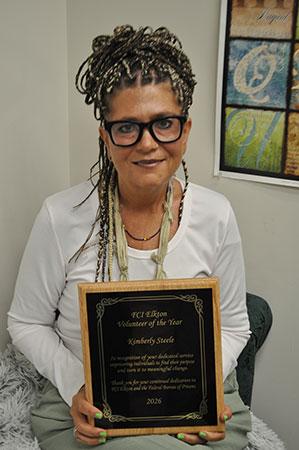
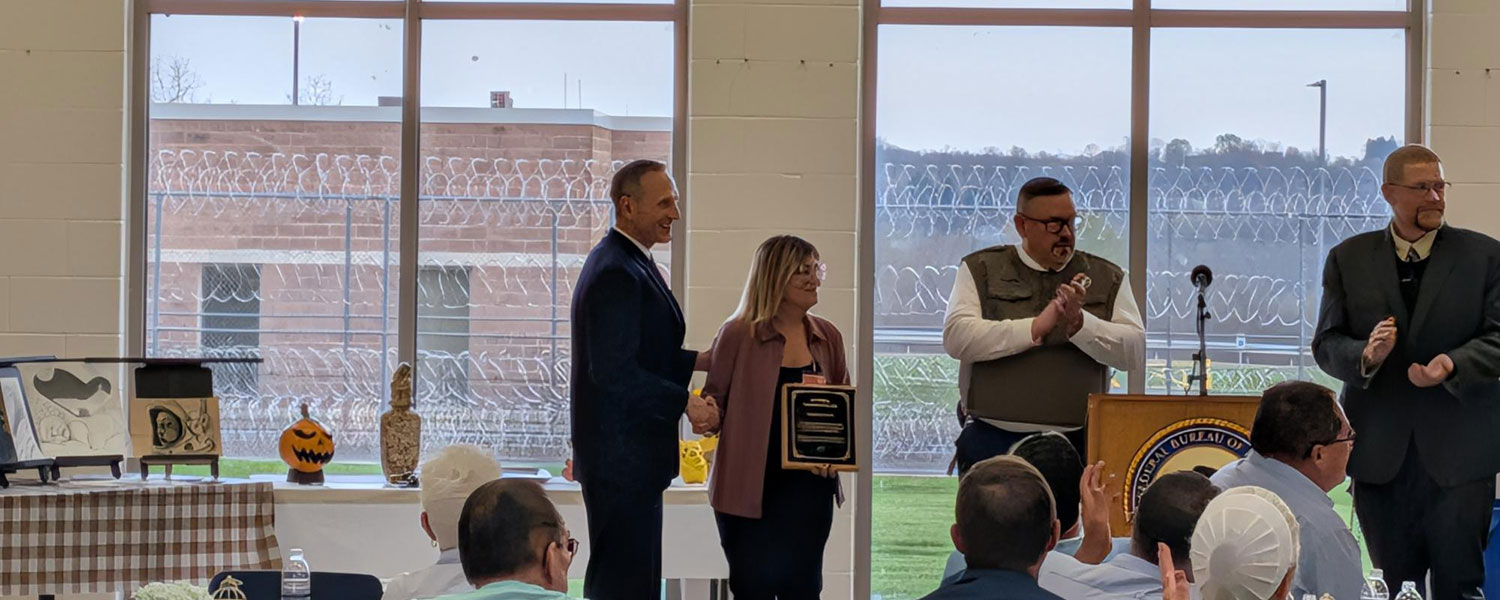
Combine all of those roles and responsibilities and it is easy to understand why Steele was recently recognized as the FCI-Elkton Volunteer of the Year.
The award presented to her stated that it was given 鈥渋n recognition of (her) dedicated service empowering individuals to find their purpose and turn it into meaningful change.鈥�
Steele noted that despite her job and the work she does at the facility, she is considered a volunteer and not a contractor. 鈥淭his includes all Kent State staff and faculty who engage with the PEP. We have a required training, an identification badge and are escorted throughout the facility,鈥� she said.
The first cohort of classes at FCI-Elkton began in January 2024 and Steele became involved with the prison education program there in January 2025 as the community outreach coordinator. Her primary role was 鈥渁nything student related.鈥� This included course registration, handling Pell grants, acquiring learning materials, course scheduling, coordinating tutors, faculty support, graduation review and serving as a liaison between faculty, students, Kent State and prison administration.
While the program began in 2024 as a 鈥淧rison Education Program Experiment,鈥� it was officially moved from experimental status to a fully approved Prison Education Program this past January. This move required an onsite Higher Learning Commission visit, review and report, as well as an extensive PEP application process through which Kent State had to demonstrate that the incarcerated students were afforded comparable services and learning experiences as campus students. Because of her role with the program, Steele was deeply involved at each step.
The students in the PEP earn the Associate of Applied Business-Business Management Technology degree, with a concentration in management and entrepreneurship. Kent State is also approved to offer the Bachelor of Technical and Applied Studies degree, but limited funding is delaying it being offered.
Once the prison鈥檚 cohort formed, students attended classes for six semesters 鈥� the last two at fulltime status which made them eligible for the Dean鈥檚 and President鈥檚 lists.
鈥淭he first cohort completed their degrees in December of 2025 with 18 graduates. Of those, 17 graduated with distinction; five graduated with 4.0 GPAs; 17 were on the President鈥檚 list; the other one was on the Dean鈥檚 list. Five were recognized as veterans. Three of the graduates started the program after earning their GEDs while incarcerated,鈥� Steele pointed out.
鈥淚t should be further noted,鈥� she continued, 鈥渢hat the cohort took their education very seriously and (students) do not receive any time off for engaging in the program. In addition, they successfully completed the program while dealing with barriers that included no electronics, no computers, no word processors. They did it old school with pen and paper 鈥� as did their professors.鈥�
Last May, Steele was asked to take on the overarching role of director of Prison Education, which also includes the Trumbull Correctional Institution (from where an onsite coordinator reports to her). She embraces the administrative duties with gusto, knowing that the final outcome is what matters most.
It is that final outcome that spurred Steele to add planning graduation ceremonies to her already-full slate of duties. 鈥淚 worked with the prison education administration at FCI-Elkton in putting together the first graduation ceremony and the formal graduation program booklet,鈥� she explained. 鈥淕raduation was complete with caps, gowns, guest speakers, a student speaker, food and music.鈥�
Tim Long, Ph.D., is an assistant professor who teaches business management technology, including at FCI-Elkton. He was quick to confirm that Steele is worthy of the recognition she received from the facility.
鈥淭his honor reflects the meaningful impact of her work and the consistency of her commitment. Taking on a new position and function is never a small task, yet Kim approached the transition with professionalism, focus and a strong sense of purpose,鈥� he shared. 鈥淗er hard work and diligence have not gone unnoticed, not only by those of us within Kent State Salem, but also by the inmates and staff at FCI-Elkton who directly benefit from her efforts. Recognition of this kind speaks to both the quality of her work and the way she carries out her responsibilities. It is a well-deserved acknowledgment.鈥�
The second prison cohort began classes May 18 with plans to complete in December 2027 or May 2028, depending on funding and scheduling.
鈥淚 think the most important thing to remember is that these are Kent State students with the same academic learning goals and expectations as a campus student,鈥� Steele offered. 鈥淚n my time with these students, I can confidently say that I have rarely seen this level of appreciation and dedication.
Student Commencement Speaker
Reflecting on the graduation ceremony held at FCI-Elkton, Steele focused on the pride and sense of accomplishment each graduate projected. While some elements of the graduation ceremony were traditional 鈥� caps, gowns, diplomas 鈥� she acknowledged that it was held under non-traditional conditions behind prison walls.
One graduate took time to put his thoughts on paper and presented it to Steele. By sharing his words, she hopes to show that this program 鈥� and its students 鈥� are worth the time spent on it.
He writes:
鈥淲e are a group of men that are from all over the United States, that came together for a common goal of earning a college degree. We were the first group of inmates to graduate from college since the prison opened in 1997. This accomplishment did not happen by accident; it was the result of the planning, support and belief from many partners. The program was supported every step of the way by the Executive Staff, the Education Department and 黑料网. From the beginning, the degree offered was chosen with intention. It was carefully selected to ensure that the skills we learned could be used upon release by someone with a criminal record, and/or to prepare us to start our own business. That practical focus gave us a renewed sense of urgency to participate in the program: the classes were not just academic exercises; they were tools we could use to rebuild our lives.
鈥満诹贤� proved to be an incredible partner. Professors came into an environment unknown to them and treated us like real students, delivering the same curriculum and learning objectives that students receive on the outside. They expected the same standards and offered the same guidance. That respect mattered. In class, for a few hours, we could mentally escape the confines around us and plan, dream and work towards futures that began to feel attainable. Working on projects, writing papers, and preparing presentations were activities that reminded us of who we wanted to become, not just who we had been.
鈥淭his program brought together men from very different backgrounds, different races, education levels, family situations and criminal charges, creating a community where we helped each other succeed. Some of us never imagined we could complete college. Others had started but never finished. Many of us had earned our GED while incarcerated. Together we learned to rely on each other鈥檚 strengths, help one another, and push through any doubt. The diversity in the group became one of the programs鈥� greatest assets; every student鈥檚 perspective made the classroom richer and every success felt collective. And鈥e did all of this without the internet, a computer, a PowerPoint projector or a word processor!
鈥淎 new cohort has just begun and our graduating class will be paying it forward by serving as tutors and peer mentors, continuing the cycle of support that we received from the University, FCI Elkton, and each other that helped us succeed. This program gave us hope for our futures in a way that is hard to overstate. For many of us, it was the first time in years we could envision a different life, one where skills and credentials could open doors. We extend our greatest thanks to everyone who believed in us, and as a group of Kent State graduates, we commit to helping the next cohort reach the same achievements and beyond. We hope this initiative continues to grow and maybe one day offer a bachelor鈥檚 degree, as well.鈥�
Cutline A: Kim Steele being recognized as Volunteer of the Year at FCI-Elkton.
Cutline B: Kim Steele